Photography is usually something everyone has already tried. Members will, thus, bring with them ideas of how and why they want to join a course. It seems best to start at the beginning!
In our experience most members will only have the 'point and shoot' type of camera. This can limit what they can usefully learn. So for this sort of member we suggest a 6 lesson plan based on fortnightly intervals. This gives members time to assimilate what you have taught them. Also we suggest giving them some projects to photograph (see below for ideas). Four weeks should be sufficient time for members to do the necessary work and get it processed.
Members can use local or internet printing companies to processing their images, unless they have a digital image processing program and can print properly. This will enable you to ask members to mount their prints on card in an artistic way as well as show a story. In turn these mounted projects can be used to show to other U3A members at coffee mornings. If you like a form of self advertising.
It is possible to aim a bit higher by trying to limit your intake to members with more versatile cameras such as SLR (single lens reflex) cameras. This enables a far more diverse subject range to be taught and a more creative approach.
Now that digital photography has become more popular we have found a need to teach members how to use their digital equipment to produce digital prints.
FUN
To make the subject fun we suggest trips to photogenic spots locally such as a local village or market or a garden. Depending where members are in their photography we would suggest you try to get them to concentrate on one aspect of photography. For instance the use of one or more compositional ideas.
We have very successfully tried out a Photographic Treasure Hunt within easy walking distance. Here we limited ourselves to 24 clues ( i.e. Individual photographs). The clues have been a mixture of straightforward 'go here' types to semi-cryptic using awful puns! We have found that this is most appreciated especially by members not familiar with the area. You will need to accompany them round in case of difficulties.
OTHER PROJECTS
We have also tried out various other ideas for projects for our students. Some are quick and easy and some can take longer, perhaps up to 3 months. They can be tailored to suit your students.1 ) 'Up and Down' or 'Worm's Eye View - Bird's Eye View'
This will get members to look and see in ways new to them, and get them into places they may never have thought of going. Also they have to grovel in a most satisfying way.
2 ) '100 metres' (OK 100 yards will do)
The idea is to restrict students to a small area chosen by themselves but allow them unrestricted use of any equipment they have. The main thing they should be trying out is all their lenses. The area they choose should clearly be of interest to them and can include a local market place or a stretch of road or garden or even 100 metres round a roundabout.
Well before the end students should find it hard to get photographs that are not repeats. So they will have think hard to find new things. It is then that they (hopefully) will start seeing photographs everywhere.
They ought to present you with only their chosen best prints preferably mounted and possibly labelled too. Maybe 8 prints will do.
3 ) U3A Calendar.
Each year the Third Age Trust has a U3A Calendar Photographic Competition. This is a good project to get your students involved in. No doubt they will all fail but at least they will have tried. Anyone who is successful will be greatly chuffed.
4 ) Autumn
We set this project up because we went away during Autumn and we thought we would like to see what we had missed. It is an excellent time for members to capture the wonderful colours.
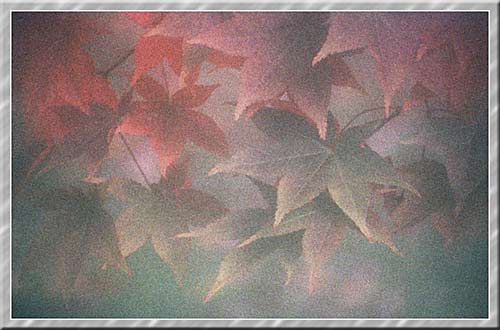
Perhaps you could try to get your students to photograph in an impressionistic way. The method for doing this is to use very fast speed setting (e.g. 1600 ISO) so that the result is as grainy as possible. Then by use a centre spot clear diffusion filter (e.g. Cokin) and a long focal length lens, about 200 mm is best.
5 ) Journalism
Maybe your U3A have courses which could be photographed such as a theatre group or perhaps your U3A is doing something newsworthy. Why not encourage your members to try being a photojournalist and producing something for the local newspaper or your own newsletter. In all probability some members will belong to such other groups which will allow them easy access via the group leader. It may come about that this could lead on to a much larger project.
6 ) Longer Projects
As we have progressed we found that our members could cope with much bigger ideas based on an interest of theirs. So we gave them 3 or 4 months to explore photographically whatever they wanted in great detail. Our students really surprised us by their ideas and their particular interests. Their presentations too were a revelation to us. They made up their projects into booklets with accompanying text to complete the story. Ideas included a study of Thomas Hardy but from the point of view of his fictional places in and around Salisbury, the Fleet Air Arm from an ex-pilot, a photographic study of Swanage but with a poem of several stanzas each stanza illustrated with the appropriate photographs, a donkey sanctuary on the Isle of Wight, and identical viewpoints used by Turner in some of his famous paintings of Salisbury.
An extremely worthwhile idea which has proved popular with students and other U3A members too.
7 ) Digital Photography
This is a new idea for us and we are still working on this area. This has come about because of demand. We have started by assuming that members know nothing and may not even have suitable equipment. So far we have written ninety four [94] articles on this topic for members guidance.
We give them homework in the form of an image via email. They will then be expected to do various digital operations such as cleaning, re-sizing and so on.8 ) Practical Photography
Another aspect that members may be interested in is something about the methods of using a camera. Some of these ideas can be seen HERE9 ) History of Photography
As a background for understanding how photography has arrived at the present a little knowledge of how it began and progressed is useful. A timeline show the progress.
Frederick Scott Archer made an important step in getting sharp clear negatives by using glass as the base instead of paper. This idea is shown here.
BibliographyDictionary of Photography by A.L.M.Sowerby, Iliffe Books Ltd., 1961 Photographing the Patterns of Nature by Gary Braasch, Amphoto Books, 1999 Practical Composition in Photography by Axel Brück, Focal Press,1981 Photo School by Michael Freeman, Macmillan, 1982 Cokin Creative Filter System Catalogue Photography Exposed by Paul & Bernard McWilliams Whitstable Litho Ltd., 1984 Camera Techniques ed. By Clyde Reynolds, Newnes Books, 1983